01277 225316 info@audiorestored.com

The Restoration Process - Audio Restored
A Simple Philosophy
The ‘true’ art of the audio restorer is to know how far to take the cleaning process. Applying insufficient restoration will result in an ineffective end result, as residual clicks, crackle and other surface noise will remain unnecessarily. On the other hand, excessive digital processing can lead to the introduction of unwanted artefacts which is unacceptable. The secret is to get the balance right.
CEDAR ADA AND DUOs
This philosophy is particularly relevant when dealing with old or severely damaged recordings. In such cases it is preferable to leave a certain amount of baseline noise in (such as a degree of groove noise on a 78) to ensure that the restored sound remains as true to the original recording as possible.
The Restoration Process
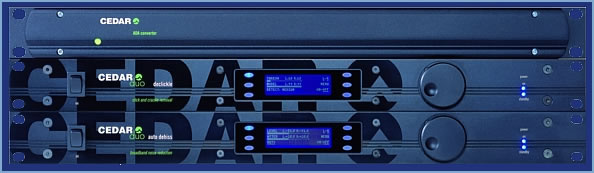
Following transcription from the appropriate source, the resulting analogue signal is fed directly to a CEDAR ADA analogue to digital converter, before applying downstream industry standard processing (CEDAR de-click, de-crackle and de-noise) technology to effectively reduce/remove the clicks, pops, crackle and hiss which inevitably accompany such transcriptions.
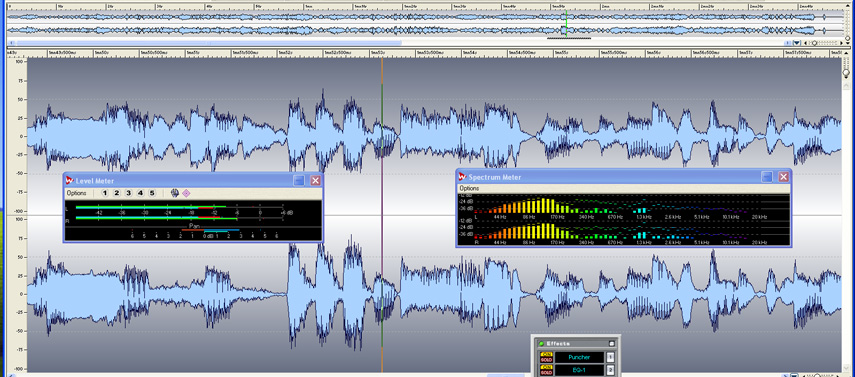
Once the recorded digital file is saved to the PC, further restoration may be necessary (e.g. reduction/removal of background noise, hum, manual removal of difficult clicks, scuffs and thuds etc.) and this is achieved using iZotope RX5 Audio Editor software, Waves plug-ins (X-noise, X-Click etc.) and Steinberg Wavelab Pro-9 software. These enhancements are inevitably more time consuming than the initial transfer, so an additional charge would be necessary, but this would be discussed with the client up front, before proceeding.
Further enhancements to the recording can be made, including optimisation of the sound levels and improvements to the clarity and tonal quality, by making subtle equalisation (EQ) and compression adjustments.
Recordings in poor condition
Inevitably, some records and tapes will have suffered the ravages of time and may be in such a poor state that satisfactory restoration will be difficult, and at worst, may even be impossible. In rare cases where nothing worthwhile can be done, the source media will be returned to the customer with no charge other than the return postage.
That said, for records and tapes in below average to poor condition, we can still apply manual restoration techniques which will undoubtedly produce a digital file showing a distinct improvement over the original source. As mentioned above, if such manual restoration is required, this will be discussed with the client before any work is undertaken, and an estimate will be produced (manual work is charged at an hourly rate). The resulting file / CD will not deteriorate further, allowing your rare, unique and valuable recordings to be salvaged for posterity.
Please contact us to discuss your requirements before sending any media.
Burn to CD
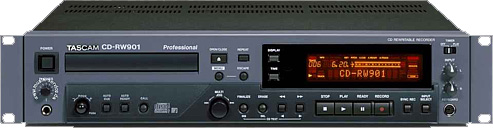
TASCAM CD-RW 901SL
The restored signal can be burned as track separated .wav files to CD-R using a dedicated CD-R burner at a slow writing speed (8x). Finally the resulting disc is QC checked for errors in both sound quality as well as CD text accuracy using a Tascam CD-RW 901SL pro CD deck.
Individual songs can be separated if appropriate to give full track skip/search functions. Where CD has been requested, text is added for convenience and the face-printed disc is returned in a clear, flexible vinyl sleeve.
Digital file uploads
Increasingly, clients are opting to receive digital .wav files which they can download to their mobile phone, laptop or PC, in preference to CDs. We use ‘We Transfer’ to upload files to your e-mail address – the link to this remains active and available for download for up to 1 month.
Alternative file formats (FLAC, .mp3) can also be accommodated if preferred – please mention this when discussing your requirements.
IMPORTANT:
All digital files produced by Audio Restored will be retained on backed-up hard drives for a maximum of 3 months. After this time, all files are wiped to comply with copyright laws.
Therefore you are strongly advised to make your own back-ups of audio material supplied.